
Guide to Installing a Replacement Refrigerant Coil
Following installation best practices play a critical role in maximizing efficiency, reliability and service life of your refrigerant coil.

Proper installation is one of the most critical factors in ensuring your refrigerant coil operates efficiently and delivers years of dependable service. The below recommendations are for refrigerant coils manufactured by Nationwide Coils. You should always follow local codes and standards for the installation of equipment and refrigerant coils for the area in which the coils are to be operated.
Refrigerant coils manufactured by Nationwide Coils are shipped with a small nitrogen holding charge. Refrigerant coils are condenser coils, DX evaporator coils and heat reclaim coils. Care should be taken when opening any refrigerant coil for installation. DX coil distributors have caps installed with soft silver solder. Once the cap is removed and if the Thermal Expansion Valve (TEV) is to be installed using anything other than soft solder, the distributor connection should be sufficiently cleaned with an emery cloth to remove the soft solder. Follow accepted refrigeration piping practices and safety precautions per ASHRAE Standards. If bends or 90s are necessary, long-radius fittings must be used to keep the pressure drop through the piping at a minimum. General recommendations for component selection and line sizing follow. Nitrogen charged and capped piping is recommended for every refrigerant coil installation.
A. Refrigerant Coil: Liquid Line Sizing
All compressors have a Refrigerant Charge Limit [RCL] that must not be exceeded. Since the RCL and pressure drop are in direct conflict with each other, Nationwide Coils recommends that the liquid line be sized as small as possible, while maintaining a low enough pressure drop to ensure 5°F of sub-cooling at the expansion valve.
B. Refrigerant Coil: Liquid Line Components
Nationwide Coils recommends the use of a properly sized liquid line filter-drier, installed upstream from the expansion valve and as close to the evaporator coil as possible. Filter-drier selection should be based on a maximum pressure drop of 2 psi at the design condition.
A moisture indicator/sight glass should be installed between the expansion valve and filter-drier. The moisture indicator/sight glass must be sized to match the size of the liquid line at the thermal expansion valve.
A liquid line shut-off valve with an access port should be sized with the selected liquid line OD, and installed close to the condenser.
The use of other valves, tube bends and reducers should be minimized to reduce sub-cooling at the expansion valve, since these items tend to increase pressure drop. Liquid line receivers, other than those factory-installed, are not recommended.
The TEV must be selected for proper size, capacity and refrigerant being used. A slightly oversized valve will allow the unit to operate satisfactorily at low-load conditions. An undersized valve should not be used at any time, as this will starve the evaporator of refrigerant causing insufficient air temperatures. The use of a hot gas bypass valve should also be considered when sizing the TEV. Select expansion valves with external equalizer connections, and those designed to operate against a backpressure of 20 pounds per square inch higher than actual evaporator pressure. The TEV must be installed directly on the evaporator coil liquid line connection provided. The liquid distributor must be in a vertical position. Ensure that the distributor nozzle is installed in the distributor, if required, and that the correct nozzle for the refrigerant being used is installed. Sensing bulbs must be mounted on a clean, horizontal suction line close to the evaporator outlet and insulated properly. The bulb must be tight against the suction line at a 10 or 2 o’clock position, but take care not to over tighten and cause damage to the sensing bulb.
The bulb should not be mounted directly on top or bottom of the suction line.
CAUTION: Disassemble the thermal expansion valve before completing the brazing connections. If necessary, wrap the valve in a cool wet cloth while brazing. Failure to protect the valve from high temperatures may result in damage to the internal components and negatively affect refrigerant coil operation.
C. Refrigerant Coil: Suction Line Sizing
Suction line tubes must be sized to maintain refrigerant vapor velocities that are high enough to ensure good oil return to the compressor under all operating conditions. It is necessary to pitch horizontal suction lines of the refrigerant coil toward the compressor to ensure sufficient oil return to the compressor. Traps should be provided at the bottom of suction line risers and at 15 foot intervals for sufficient oil return.
D. Refrigerant Coil: Suction Line Components
A suction line pressure tap should be installed on the leaving side of the evaporator coil near the TEV sensing bulb location. Accurate superheat measurement and TEV adjustment demands that suction pressure and temperature be measured near the evaporator coil outlet.
Suction line filter-driers are usually only necessary on systems that have experienced a severe compressor motor burnout or other failure that results in extremely high refrigerant temperature. This filter-drier should not be left in the suction line permanently.
Suction lines should be insulated completely with sufficient wall thickness insulation for the application temperature range being utilized.
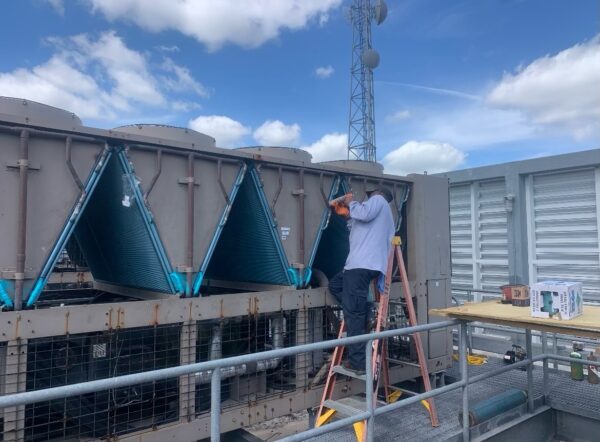
Installation Checklist
Use the following checklist to verify that all necessary installation procedures have been completed for your refrigerant coil.
- Refrigerant coils are installed with airflow in same direction as indicated on the coil nameplate or casing.
- Suction connection is at the bottom of the suction header on the evaporator coil; suction line is pitched towards compressor and traps are installed in suction risers. Suction line is insulated with correct wall thickness insulation for the temperature application utilized.
- Condensate drain pans and piping are installed with a trap in the condensate line; piping insulated and heated, if installed in applications that are below freezing.
- Clean filters are installed upstream of the condenser coil, when applicable.
- A liquid line filter-drier is installed upstream of the expansion valve.
- A moisture indicator/sight glass is installed between the expansion valve and filter-drier.
- A liquid line shutoff valve with access port is installed close to the condenser.
- A Schrader valve is installed in the suction line close to the evaporator coil outlet.
- The TEV, with external equalizer connections, is installed directly on the evaporator liquid connection, sensing bulb mounted in the horizontal position on the suction line and insulated. The liquid distributor must be in a vertical position.
- Piping system is leak-tested with dry nitrogen, evacuated to 500 microns, and charged with correct refrigerant type and amount.
- Superheat and sub cooling measurements are taken. Thermal expansion valve is adjusted to obtain desired superheat. Desired superheat on most applications is 8° to 12° at the outlet of the evaporator.
Protect your refrigerant coil investment by following the above installation best practices. Should need a replacement refrigerant coil or have a question, do not hesitate to contact your Nationwide Coils team.